If you've pulled out your old air filter and found the size stamped on the frame reads 12x26.5x4, you're probably wondering: is this a standard size, or do I have an unusual system on my hands? The short answer is that this dimension falls outside the most common residential filter footprints — but that doesn't mean it's rare or hard to find. Understanding why your system uses this specific size can actually tell you quite a bit about the equipment installed in your home.
The 12x26.5x4 air filters belong to a category of deeper, high-capacity filters designed for HVAC systems with wider filter slots. The 4-inch depth, in particular, is a meaningful distinction — it holds more filtration media than a standard 1-inch filter, extends replacement intervals, and tends to support higher MERV ratings without the airflow restrictions that thinner filters can create. If your system uses this size, it was likely engineered for better-than-average filtration performance.
TL;DR Quick Answers
Are 12x26.5x4 Air Filters a Standard Residential Size?
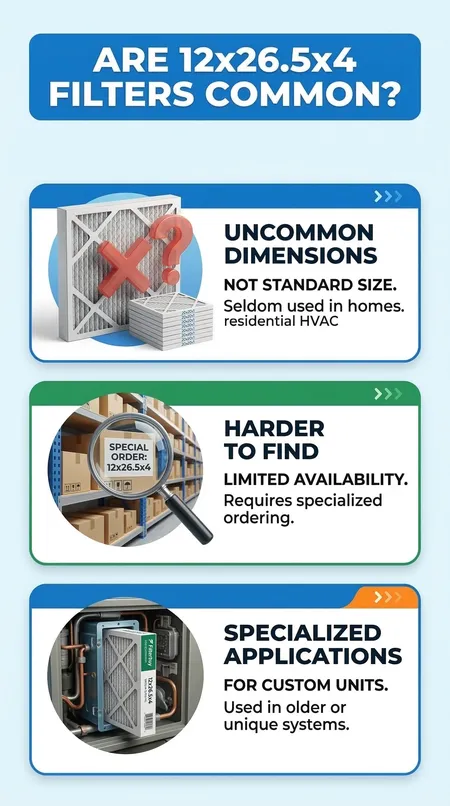
Not universally standard, but not uncommon.
The 12x26.5x4 size fits select residential HVAC systems with wider, deeper filter slots.
The fractional 26.5-inch width indicates a brand- or model-specific slot dimension.
4-inch-deep filters are increasingly common in newer, higher-efficiency residential systems.
Available in MERV 8, MERV 11, and MERV 13 ratings.
Always verify your actual slot dimensions before ordering — nominal sizes can vary slightly from actual.
Top Takeaways
The 12x26.5x4 filter is not a universal standard size, but it is a recognized residential dimension tied to specific HVAC equipment configurations.
The fractional 26.5-inch width is engineered for a precise fit — never round up or down significantly when ordering a replacement.
The 4-inch depth is a performance advantage: more media, longer life, and better MERV compatibility.
MERV 8 is a starting point; MERV 11 or 13 is worth considering if anyone in your home has allergies, asthma, or respiratory conditions.
Measure your actual filter slot before every first-time order — nominal and actual dimensions sometimes differ by ¼ to ½ inch.
Why the 12x26.5x4 Dimensions Matter
The Fractional Width Signals a Specific System Design
Most homeowners are used to whole-number filter dimensions — 16x25x1, 20x20x4, and similar. The fractional 26.5-inch width in the 12x26.5x4 filter is the first signal that this size is tailored to a particular HVAC manufacturer's equipment. Some major HVAC brands engineer their return air cabinets or filter housings to precise fractional dimensions for a tighter, more effective seal. A perfect fit matters more than many homeowners realize — even a half-inch gap at the frame's edge allows unfiltered air to bypass the media entirely.
The 4-Inch Depth Is the Real Performance Story
In residential air filtration, depth is often overlooked. But in our experience working with homeowners across a wide range of HVAC configurations, the jump from a 1-inch to a 4-inch filter is among the most impactful upgrades a home system can support. Here's why:
More surface area. A 4-inch pleated filter holds far more filtration media in the same footprint.
Longer service life. Most 4-inch filters are rated for 6 to 12 months between replacements, versus 30–90 days for 1-inch filters.
Less airflow restriction. Counter-intuitively, a deeper pleated filter at a higher MERV rating can restrict airflow less than a thin 1-inch filter at the same rating, because the increased media area reduces resistance.
Higher MERV compatibility. Many residential HVAC systems can support MERV 11 or MERV 13 in a 4-inch format, where a 1-inch filter at the same MERV would create problematic static pressure.
Is Your System Compatible?
Not every air handler accommodates a 4-inch filter. If your system has a dedicated 4-inch filter cabinet or a wide return-air slot, you're in the right configuration. Key compatibility checks:
Measure the actual slot opening — not just the old filter's label.
Confirm the slot depth is at least 4 inches.
Check your HVAC manufacturer's documentation for maximum MERV rating recommendations.
If you're unsure, consult a licensed HVAC technician before upgrading filter thickness.
Choosing the Right MERV Rating for a 12x26.5x4 Filter
The MERV scale — developed by ASHRAE — rates a filter's ability to capture particles ranging from 0.3 to 10 microns. For a 4-inch filter in this size, common choices include:
MERV 8 — captures dust, pollen, lint, and larger debris. Good baseline protection.
MERV 11 — adds pet dander, mold spores, and finer particulate. Better for households with pets or mild allergy concerns.
MERV 13 — filters fine particles, smoke, and some bacteria. Recommended by the EPA for households with respiratory sensitivities.
"In our years of manufacturing air filters across hundreds of size configurations, the one thing we've consistently seen is that homeowners with 4-inch filter systems dramatically underestimate how much performance they're leaving on the table by defaulting to a low MERV rating. A properly fitted, high-MERV 4-inch filter does two jobs well: it protects the equipment and improves the air your family breathes — without the airflow penalty people fear."
Essential Resources on "12x26.5x4 Air Filters"
1. What Is a MERV Rating?
The EPA's plain-language explanation of how MERV ratings are determined, what particle sizes each rating targets, and how to select the right rating for your HVAC system.
Source: https://www.epa.gov/indoor-air-quality-iaq/what-merv-rating
2. Introduction to Indoor Air Quality
EPA's foundational overview of indoor air pollutants, their health effects, and how HVAC filtration plays a role in reducing exposure inside the home.
Source: https://www.epa.gov/indoor-air-quality-iaq/introduction-indoor-air-quality
3. ASHRAE Standard 52.2 — Method of Testing General Ventilation Air-Cleaning Devices
The ASHRAE standard that defines how MERV ratings are tested and assigned. Essential for understanding the science behind filter performance specifications.
Source: https://www.ashrae.org/technical-resources/bookstore/standards-52-1-52-2
4. How to Keep Your HVAC System Working Efficiently
ENERGY STAR's practical guide to maintaining your heating and cooling system, including the role of clean air filters in preventing equipment strain and energy waste.
Source: https://www.energystar.gov/products/ask-the-experts/how-keep-your-hvac-system-working-efficiently
5. Indoor Air Quality: The Inside Story — A Guide for Homeowners
A comprehensive EPA consumer guide explaining indoor air pollution sources, health impacts, and actionable steps homeowners can take — including HVAC maintenance and filtration.
Source: https://www.epa.gov/indoor-air-quality-iaq/inside-story-guide-indoor-air-quality
6. EPA Indoor airPLUS Filtration Technical Bulletin
A detailed EPA technical bulletin outlining HVAC filtration best practices for new residential construction, including minimum MERV requirements and filter installation guidance.
Source: https://www.epa.gov/sites/default/files/2020-06/documents/2019.11_tech_bulletin_filtration.pdf
7. Building Science Education: HVAC Proper Installation of Filters
A U.S. Department of Energy resource covering correct filter placement, sizing, and the relationship between filter depth and system airflow — directly relevant to 4-inch filter configurations.
Source: https://bsesc.energy.gov/energy-basics/hvac-proper-installation-filters
Supporting Statistics
1. Americans spend roughly 90% of their time indoors, where pollutant concentrations are often 2 to 5 times higher than outdoor levels, according to the EPA.
This isn't just a number to acknowledge — it fundamentally reframes where filtration matters most. Your HVAC filter isn't a passive accessory; it's actively working to clean the air where you live, sleep, and spend most of your life.
https://www.epa.gov/report-environment/indoor-air-quality
2. A dirty air filter forces your HVAC system to work harder, increasing energy costs and accelerating equipment wear, according to ENERGY STAR .
For 4-inch filters like the 12x26.5x4, this is especially relevant: because these filters have a longer service life, it can be easy to forget to replace them on schedule — which negates the deeper media advantage and puts unnecessary strain on the blower motor.
https://www.energystar.gov/products/ask-the-experts/how-keep-your-hvac-system-working-efficiently
3. The EPA recommends a minimum of MERV 13 for households where improved filtration of fine particles is a priority, while the DOE's Zero Energy Ready Home program sets MERV 8 as its baseline minimum
The gap between those two benchmarks is where most residential decision-making happens. A 4-inch filter in the 12x26.5x4 format gives you the structural support to reach MERV 11 or MERV 13 without the airflow trade-offs that would come with a thinner format at the same rating.
https://www.epa.gov/indoor-air-quality-iaq/what-merv-rating.
Final Thought & Opinion
The 12x26.5x4 filter size asks a simple question of the homeowner: are you using it to its potential? In our experience, households that have 4-inch filter systems frequently underperform them — running MERV 8 filters, waiting too long to replace them, or buying the cheapest available option without considering MERV rating. That's a missed opportunity.
This size was designed for higher-capacity filtration. It supports longer replacement intervals and better particle capture at MERV ratings that thinner filters struggle to sustain without restricting airflow. If your system accommodates a 12x26.5x4 filter, consider:
Moving to MERV 11 at minimum, especially if pets or allergies are factors.
Setting a calendar reminder every 6 months for inspection; replace at 6–12 months depending on household conditions.
Verifying your actual slot dimensions once, then storing that measurement somewhere accessible for future orders.
Don't let an uncommon filter size be the reason you default to poor filtration. The right fit in the right MERV rating makes a measurable difference.
FAQ on "12x26.5x4 Air Filters"
Q1: Is the 12x26.5x4 a standard air filter size?
A: Not universally standard, but it is a recognized residential size.
Tied to specific HVAC manufacturers and equipment models.
Available from reputable filter suppliers in MERV 8, 11, and 13.
The fractional 26.5-inch width indicates a precision-fit design.
Q2: How often should I replace a 12x26.5x4 air filter?
A: Replacement frequency depends on usage and household conditions.
General guideline: every 6–12 months for a 4-inch filter.
Replace sooner in homes with pets, heavy dust, or occupants with allergies.
Check the filter visually every 3 months — if it looks gray or clogged, replace it.
Q3: What MERV rating should I choose for a 12x26.5x4 filter?
A: Match MERV rating to your household's needs:
MERV 8: Basic dust and pollen protection; sufficient for low-sensitivity households.
MERV 11: Better choice for pet owners and mild allergy sufferers.
MERV 13: Recommended when respiratory health, fine particles, or smoke are concerns.
Confirm your HVAC system supports MERV 13 before upgrading — check manufacturer specs.
Q4: Why does the 12x26.5x4 filter have a fractional dimension?
A: Fractional dimensions like 26.5 inches indicate manufacturer-specific filter housing.
The filter is sized to create a precise, sealed fit inside a specific HVAC cabinet.
Do not substitute a whole-number filter (such as 12x27x4) without verifying it fits correctly.
Gaps around the filter frame allow unfiltered air to bypass the media — defeating the filter's purpose.
Q5: Can I use a thinner filter (1-inch or 2-inch) in a 4-inch slot?
A: Technically possible with an adapter, but not recommended.
A thinner filter in a 4-inch slot creates significant gaps where air bypasses filtration.
4-inch slots are designed for the full-depth filter — use the correct thickness.
If 4-inch filters are difficult to source, consult an HVAC professional before substituting.
Ready to Protect Your System?
Finding the right 12x26.5x4 air filter doesn't have to be complicated — once you know your size and the MERV rating that fits your household, regular replacements become a simple, high-value part of your home maintenance routine. If you're unsure which MERV rating is right for your system, our team is here to help you find the best fit.
Learn more about HVAC Care from one of our HVAC solutions branches…
Filterbuy HVAC Solutions - Miami FL - Air Conditioning Service
1300 S Miami Ave Apt 4806 Miami FL 33130
(305) 306-5027
https://maps.app.goo.gl/Ci1vrL596LhvXKU79